

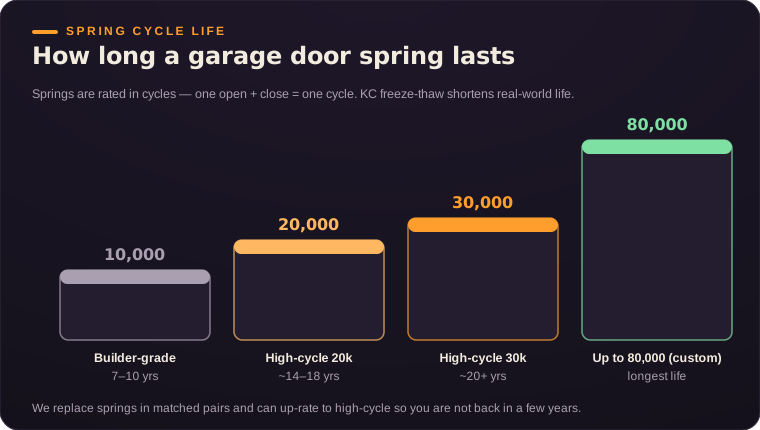
Standard torsion springs are rated for 10,000 cycles — roughly 7–10 years at three to four open/close cycles per day. In Kansas City's climate, with 25–35 freeze-thaw cycles every winter, springs often reach the end of their life on the shorter end of that range. Knowing the warning signs before a spring breaks keeps you out of an emergency situation and usually saves money. This guide walks through how springs are rated, what Kansas City's weather does to them, and how to tell when yours are getting close. The warning signs are specific: a loud bang when the spring snaps, a door that lifts two to three inches then stops, a visible gap in the coil above the door, or an imbalanced door on the manual balance test (one side heavier than the other). January and February are the peak-failure months in KC — cold nights make steel more brittle, and fatigued springs snap under the morning load. When you reach that point, Garage Door Masters KC handles spring replacement across the metro — same-day service, parts on the truck, $79 service call credited toward the job. Bonded and insured, 4.9 stars from 490+ KC neighbors.

5 warning signs your spring is close to failing
- Door feels unusually heavy to lift manually — pull the emergency release and try to lift the door by hand. A properly balanced door rises with modest effort; if it feels like you are lifting 50+ lbs, the spring is no longer providing full counterbalance.
- Visible gap or separation in the coil — look at the spring above the door. Any visible crack or gap between coil winds means the metal has already fractured. Do not operate the door; call for same-day service.
- Loud squealing or grinding from the spring area — surface corrosion or unusual stress on the coil. Lubrication may quiet it temporarily, but a professional inspection will tell you whether the spring is near end-of-life.
- Door jerks or one side moves faster than the other — on a two-spring system, uneven tension causes the door to tilt during travel. One spring has lost significantly more tension than the other and is nearing failure.
- Opener strains, motor light activates, or travel slows — your opener is compensating for a failing spring by working harder than it was designed to. Running it this way consistently risks burning out the motor before the spring officially breaks.

How garage door spring ratings work
Every garage door torsion spring has a rated cycle life stamped or recorded by the manufacturer. One cycle is one full open and one full close of the door. Here is how the standard tiers break down:
- 10,000 cycles (standard) — the default spring installed by most manufacturers and the default we carry. At three to four cycles per day — a household with one driver — that is roughly 7–10 years of life. At five to six cycles per day (two cars, active family), more like 4–6 years.
- Custom high-cycle (up to 80,000 cycles, in-house) — a direct upgrade available on any torsion spring job. Built with heavier-gauge wire and wound tighter from the factory. Lasts far longer than a standard spring under the same daily use. More expensive upfront; typically means one replacement instead of two or three over 20 years of ownership.
- Commercial-grade high-cycle (the same 80,000-cycle springs) — used on high-use commercial doors: warehouses, loading docks, parking structures. Not typically needed for residential garages, but sometimes specified for a home with an unusually high cycle count (multiple families, home-based business with frequent deliveries).
The cycle rating assumes average use under moderate conditions. Kansas City's climate is not moderate — and that changes the math.
What Kansas City's freeze-thaw climate does to springs
Kansas City averages 25–35 freeze-thaw cycles per winter — days where temperatures cross 32°F going both directions, sometimes multiple times within 24 hours. For a garage door spring, this matters in two ways.
Thermal contraction accelerates fatigue. Steel contracts when it gets cold. For a torsion spring that is already pre-wound under load, contraction increases the tension in the coil. A spring that is operating at the edge of its fatigue life — not broken yet, but close — is most vulnerable at the moment temperatures drop sharply. That is why the classic KC spring-break scenario is the morning of the first hard freeze: homeowner hits the button, nothing happens, spring is broken. The spring did not fail because of the temperature alone — the temperature was the last straw on a spring that was already near the end.
Rust and corrosion shorten effective life. KC's humidity, spring rain, and summer heat create conditions where untreated metal corrodes faster than in drier climates. Rust pits the coil surface, creating stress-concentration points where fatigue cracks initiate faster. In our experience, springs on doors we inspect that have gone years without lubrication consistently show rust and pitting we don't see on maintained hardware — the corrosion accelerates fatigue crack initiation, and we replace those springs sooner than their cycle rating would suggest. We apply a proper garage-door lubricant to the spring coils at every tune-up for exactly this reason.

The practical result: standard 10,000-cycle springs in a KC garage often perform more like 7,000–8,500 effective cycles before they are at risk of failure — not because they were defective, but because the climate extracts a real cost from every coil.
There is also a generational dimension to this pattern. A large share of Kansas City metro's housing stock — neighborhoods in Leawood, Olathe, Overland Park, and Shawnee — was built during the development surge of the late 1980s and 1990s. Those homes are now 30–40 years old. Even with one spring replacement roughly every 7–10 years, many of these garages are on their second or third set of springs, and some have never had a replacement at all. If your home dates from that era and you are not certain of your springs' history, a pre-season inspection is worth scheduling — it takes 45–60 minutes and removes the uncertainty.
January and February: KC's spring failure peak season
If you look at our service call volume by month, January and February stand out clearly as the spring repair peak. The pattern is consistent year over year.
Here is what drives it:
- Accumulated fatigue. Springs that have been working through fall — warm days, cool nights, moderate stress — arrive at deep winter with whatever cycles they have left. The most worn springs in the KC metro are sitting at home right now, waiting for the right cold snap.
- Thermal contraction at the brittle point. As described above, a fatigued spring under thermal contraction is at its highest risk. The first hard freeze of January is the most dangerous moment for a spring that is late in its life.
- Weather lock-in. When a spring breaks in January, you cannot simply leave the door open while you wait for a repair — temperatures mean you need the garage enclosed. The December 2022 winter storm illustrated this sharply: temperatures dropped roughly 40°F in under 24 hours across the metro, and homeowners dealing with a broken spring during that stretch had no real options except immediate same-day service or an unsecured garage in sub-freezing weather. The urgency is higher in January, which is why same-day service that month is especially important to us.
The takeaway: if your springs are more than six or seven years old and you have not had a tune-up recently, scheduling one in October or November — before the freeze-thaw season — is the highest-value preventive maintenance you can do for your garage.
Warning signs your springs are getting close
Springs rarely break without any notice. These are the signals to watch for:
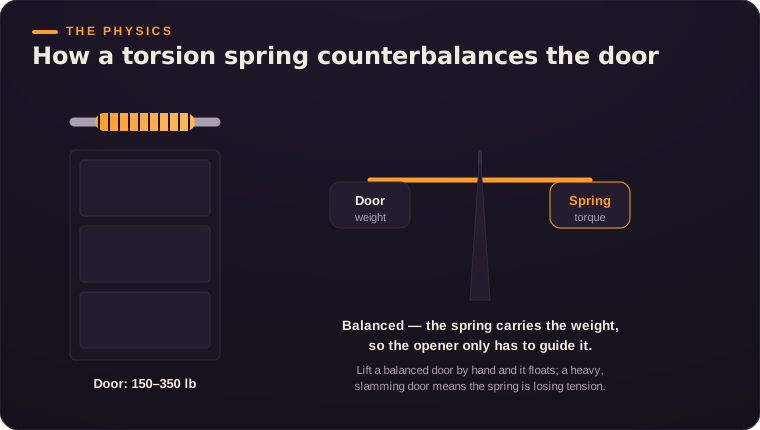
- Door feels heavier than it used to. When you pull the emergency release and try to lift the door manually, it should rise with modest effort — a properly balanced door is nearly weightless because the spring is doing the lifting. If it feels like you are lifting 50 lbs or more, the spring is not providing full counterbalance. That is a sign it has lost tension and is nearing failure.
- Loud squealing or grinding when the door moves. Some noise from metal hardware is normal, especially in cold weather. Loud, consistent squealing from the spring area — not the rollers or hinges — suggests the coil surface is corroding or the spring is under unusual stress. Lubrication may solve it temporarily; inspection will tell you if it is more than that.
- Visible rust, pitting, or gaps in the coil. Walk to your garage and look at the spring mounted horizontally above the door. If you can see rust, orange discoloration, or — most critically — any separation between coil winds, the spring is in its final phase. A gap in the coil means the metal has already cracked at that point and the spring is no longer providing consistent tension. Do not operate the door — read what to do when a spring breaks and call us.
- The door jerks or one side moves faster than the other. On a two-spring system (standard on wider doors), uneven spring tension produces uneven lift. The door may tilt to one side, run cables unevenly, or jerk at the start of travel. This is often the first visible symptom that one spring has lost significant tension ahead of the other.
- The opener strains, runs slowly, or its motor light activates. Your opener motor is not designed to lift a full-weight unbalanced door. If the spring has lost tension, the opener picks up the slack — and you will hear it: slower travel, louder motor, the safety light coming on. Running an opener against a failing spring consistently burns out the motor. We have seen plenty of jobs where the homeowner needed both a spring replacement and a new opener, when the opener would have been fine if the spring had been caught sooner.
- The door does not stay open when you disconnect the opener. A balanced door, when raised to the halfway point and released from the opener, should stay put or drift only slightly. If it falls back down, the spring is no longer providing sufficient counterbalance. If it flies up, the spring may be over-tensioned. Either way, the spring adjustment is off.
The paired-replacement case: why we replace both springs
This comes up at nearly every spring job, so we want to explain our reasoning clearly and honestly.
When one spring breaks on a two-spring torsion system, the other spring is virtually the same age, was manufactured in the same batch, has been exposed to the same weather cycles, and has been under the same tension stress. Its fatigue life is nearly exhausted — often within weeks to a few months of the spring that just broke. If we replace only the broken spring, you are likely to have another service call in the near future. We charge the $79 service call fee on that second visit because it is a second visit — and the labor to set up is most of the cost regardless of how many springs we change.
Replacing both springs in one visit means one service call fee, one labor charge, matched spring tension from a fresh pair wound together, and a system that is balanced correctly. The parts cost for a second spring is real, but it is almost always the right economic call when the first spring breaks. We walk you through both options at every job and let you decide — but the honest recommendation is almost always to do both.
Standard vs. high-cycle springs: the upgrade decision
When your springs need replacement, you have a choice to make: replace with standard 10,000-cycle springs (same spec as what you had), or upgrade to custom high-cycle springs (up to 80,000 cycles, built in-house). Here is a straightforward way to think about it.
If you are an average KC household — one or two cars, three to four cycles per day — standard springs will last roughly 7–10 years. High-cycle springs at the same usage rate will last far longer — roughly 18 to 22 years in practice, because real-world spring life is usually capped by rust and metal fatigue long before the full 80,000-cycle rating is reached. Over 20 years of home ownership, you would pay for two or three standard spring sets (plus service calls each time) versus one high-cycle set (plus one service call). In most scenarios, the high-cycle springs can pay off over the ownership period despite the higher upfront price.
High-cycle springs also make more sense if:

- You have a high-use household — two or more drivers using the garage five to six times per day
- You have a home-based business with frequent deliveries or client visits
- You are planning to stay in the home long-term and want to minimize service disruptions
- You have already replaced springs once and want to extend the replacement interval
Standard springs make sense if budget is a significant constraint at the time of the call, or if you expect to sell the home in the next few years. We walk you through both options on every spring job and give you the cycle-math so you can make an informed call. If the upfront cost of high-cycle springs is a factor, our financing partner is available — ask when we arrive.
What a spring replacement visit looks like
Here is the typical sequence when you call us for a broken or failing spring:
- You call or book online. We aim for same-day service on spring calls — they are one of the most common and most disruptive failures we see. We call or text 10–30 minutes before arriving.
- Arrival and inspection. We assess which spring(s) failed, inspect the cables, drums, and cable anchors for damage caused by the spring failure (a failing spring can snap a cable or unspool a drum), and check the opener and sensors.
- Flat-rate quote before any work starts. The $79 service call fee is credited toward the repair. You see the full cost — spring(s), labor, any additional hardware — before we begin.
- Spring replacement. We remove the broken spring(s), install the new set sized and tensioned to the exact door weight (measured at the visit, not estimated), wind and balance the spring tension so the door lifts evenly, and verify auto-reverse and force settings on the opener.
- Full operational test. We run the door through multiple cycles, test the photo-eye sensors, confirm the auto-reverse engages properly, and check that all remote controls and wall buttons are working.
- Lubrication included. A proper garage-door lubricant on the new springs, all hinges, and rollers as part of every spring job — not an add-on.
Most spring replacements — including the inspection, replacement, and full test — take 45 minutes to 90 minutes depending on spring type and any related hardware.
Is DIY spring replacement safe?
We will be honest: torsion spring replacement is genuinely dangerous, and it is one of the few garage door tasks we advise strongly against DIYing. Here is why.
A torsion spring stores a significant amount of energy — the spring is wound under tension to counterbalance a 150–350 lb door. When a spring breaks or is mishandled during replacement, it releases that energy almost instantly. An improperly wound spring that lets go can cause severe lacerations, broken bones, or worse. The winding bars, the cone hardware, and the spring itself are all under load throughout the replacement process.
Extension springs — the type used on older single-car doors, running horizontally above the horizontal tracks — are somewhat safer to handle but still require safety cables through the center of the spring to contain it if it breaks during operation. An extension spring without a safety cable through it is a projectile if it fails.
This is not an attempt to upsell a service call. It is the reason professional spring replacement exists: the hardware is inherently hazardous during replacement, and the skill and equipment to do it safely takes time to learn. We carry the winding bars, the torque-calibrated tools, and the replacement experience for exactly this reason. The $79 service fee is applied toward the repair — it is not a trip charge on top of your parts cost.
Proactive spring care: the KC tune-up timing guide
The single most effective thing a KC homeowner can do to extend spring life is schedule a tune-up in October or early November — before the first hard freeze of the season. Here is what that visit covers for springs specifically:
- Visual inspection of both springs for rust, pitting, coil gaps, or signs of overextension
- Tension check — measuring door balance manually to confirm the spring is still providing full counterbalance
- A proper garage-door lubricant on the spring coils to prevent corrosion through the winter
- Cable inspection for fraying or uneven wear that a spring issue can cause
- Honest assessment: if the springs are getting close to end of life, we tell you — and you can plan the replacement on your schedule rather than on the spring's schedule
A tune-up that catches a near-end-of-life spring in October saves you from a January emergency call where the door is stuck, the garage is cold, and you need same-day service. That is a much better outcome for everyone. See what our full 30-point tune-up covers.