“
Our tech was excellent! Came out on short notice on a Sunday. Five stars, and would wholeheartedly recommend to anyone looking for garage door repair or replacement.
JC
J & C S.★★★★★ · Google


A broken garage door spring is the most common — and most urgent — repair.
A broken garage door spring is the most common and most urgent garage door repair. The torsion spring stores enough tension to counterbalance a 150–350-lb door. When it snaps—usually with a sound like a gunshot—the door becomes a dead weight the opener can't safely lift. Don't run the opener repeatedly: you risk burning out the drive gear or jumping a cable, turning a spring job into a bigger repair. In Kansas City, January and February are peak failure months—Kansas City's repeated freeze-thaw winters make fatigued steel brittle at the coil's weakest point, and the first hard cold morning of the season is when failing springs let go. Garage Door Masters KC, based in Olathe, replaces springs in matched pairs (never just the broken one), sizes each spring to the door's exact weight, and rebalances the door before leaving. The $79 service call applies toward the repair, and most spring jobs are finished in one 45–60-minute visit across the KC metro.
A loud BANG from the garage, a door that won't lift, a visible gap in the spring above the door, or the opener straining and giving up.
We size new springs to your exact door, replace them in matched pairs (so the door stays balanced and you don't get a repeat failure), wind them to spec, rebalance and safety-test. Most spring jobs are done in about an hour.
Our service call is $79 and goes toward the job if we do the work the same day — and the price we quote is the price you pay. A real local tech comes out, often the same day, with the common parts already on the truck.
Same-day service at a fair price for a tension spring. Exactly what you want when the door won't open.

Most homeowners already know something broke — there was a loud bang, possibly late at night or early in the morning, and now the door won't open. But if you didn't hear the snap, here is how to confirm the spring in five seconds without touching anything: look up at the horizontal tube above the garage door. On a standard residential setup you will see a tightly wound coil on each side of the center bracket. If one coil has a gap — a separation of an inch or more where the coil is visibly split or unwound — that spring is broken. You don't need to get close. The gap is visible from the garage floor.
If the spring looks intact, run through this quick sequence. Try the wall button (not the remote). Does the opener motor run and the trolley move, but the door stays down? That is a classic broken-spring result: the opener is moving, but the door is a dead weight it cannot lift without spring counterbalance. The opener's safety clutch will typically shut it down within a second or two to prevent motor damage. If the opener is straining audibly — a grinding or laboring sound — and the door barely moves before the motor stops, that is also a broken spring. A functioning spring makes the opener feel almost effortless.
One less obvious scenario: the door opens two to four inches and then the opener stops. The opener is trying, the spring is not broken entirely — it may have an extension spring start to separate at its end hook, or a torsion spring with a tight hairline crack that has not opened fully yet. Do not keep pressing the button. That partial failure will become a full break soon, and running the opener puts all the load onto the remaining intact portion of the spring and onto the opener and cable drums, which are not built to lift an unbalanced door and can let it drop. Call us and describe what you saw — we will confirm over the phone whether it sounds like a full break or a spring on its last legs, and dispatch accordingly.

A note on safety while you wait: do not attempt to manually lift the door if you suspect a broken spring. A standard double-car door weighs 150 to 350 pounds without spring assist. Even if you can get it moving, the door will drop instantly the moment you lose your grip, and an uncontrolled drop from any height is a serious injury risk. If your vehicle is trapped in the garage, call us and we will tell you the safest way to handle it for your specific door setup — do not improvise.
There are two spring designs used in residential garage doors, and they fail differently. Knowing which type you have helps you describe the situation when you call and understand what the tech is working with when they arrive. The most common type in KC metro homes — particularly any door installed or replaced in the last 20 years — is the torsion spring. It sits horizontally on a steel tube directly above the door opening, mounted to a center bracket bolted into the header wall. When the door closes, the spring winds tighter, storing energy. When the door opens, the spring unwinds and that stored energy assists the lift. A broken torsion spring usually fails with a sharp bang and produces a visible gap or split in the coil.
Extension springs are the older design and are more common on older and economy doors. They run horizontally along the horizontal tracks on each side of the door, stretching under tension when the door closes and contracting to assist opening. Extension springs are typically connected to the door via pulleys and cables, and they work under stretch rather than twist. When an extension spring breaks, it usually snaps with a loud crack and the broken end whips free. Extension springs are required by code to have safety cables running through them — so that if the spring shatters, the cable contains the flying end. If your extension springs do not have safety cables, that is a hazard we address at every job.
The practical difference when one breaks: a single broken torsion spring on a two-spring setup leaves the door with half its counterbalance — one spring is still wound and the door is lopsided. On a single-spring torsion setup (common on single-car doors and some double doors), a broken spring means zero counterbalance and the door cannot be lifted safely even by hand. A broken extension spring removes the assist on one side entirely, which can cause the door to tilt badly and jump the track if the opener is run. In either case, stop operating the door and call us.
When we arrive, the first thing we do is identify the exact spring size: wire diameter, inside diameter, and length for torsion springs; length and part number for extension springs. Getting the size wrong means a spring that either lacks the torque to counterbalance the door properly or is wound so tight it over-assists and makes the opener fight to hold the door down. We measure the door weight directly using a digital scale for any door where the original spring data is not stamped on the existing hardware. Correct sizing is not a detail — it is what separates a spring that lasts its full cycle life from one that breaks again in two years.
If you ask any KC garage door tech which months they run busiest, the answer is always January and February, with a secondary spike in late November when the first hard freezes arrive. This is not a coincidence — it is metallurgy. Steel becomes measurably more brittle in cold temperatures, a property called ductile-to-brittle transition. A spring that has been cycling for 8 to 10 years and has small stress cracks from metal fatigue will hold together fine through a mild autumn but fail suddenly on the first sub-20-degree morning of the year. The last bit of ductility that was holding those micro-cracks together disappears in the cold, and the spring lets go.
Kansas City's climate is particularly hard on springs because the metro does not have gradual winters — it has swing winters. A week of 5-degree lows in January is followed by a 55-degree week in February, followed by another cold snap in March. Each warm-up causes the spring steel to relax and re-expand; each cold-down contracts it again. These thermal cycles work the metal at the coil-to-coil contact points, which is exactly where fatigue cracking starts. In a climate like San Diego that holds between 50 and 80 degrees year-round, a spring may last its full rated 10,000 cycles. In KC, that same spring under the same usage load often fails at 7,000 to 8,000 cycles because the temperature cycling adds a fatigue mechanism that simple mechanical wear doesn't.
The specific time of day matters too. Many KC spring breaks happen between 6 and 9 a.m. in winter — the window when garage temperatures are at their lowest after overnight cooling, and the door has its maximum daily usage. Homeowners heading to work are the ones who find the door won't open. The bang that woke them at 4 a.m. was the spring finally giving up at the coldest point of the night, when the overnight temperature hit bottom. By morning when they try to leave, the door is a dead weight.

For KC homeowners with springs that are 8 years old or older: a pre-season inspection in September or October is the most cost-effective thing you can do. We can check the spring for rust, check the coil-to-coil contact points for wear, and measure the door balance. A spring that is fatigued but not yet cracked will show up as a door that has lost its balance — it won't hold still at mid-travel, or the opener is working noticeably harder than it used to. Catching that before the failure lets you replace it on your schedule and your terms rather than on a January morning when the whole KC metro is calling at once.
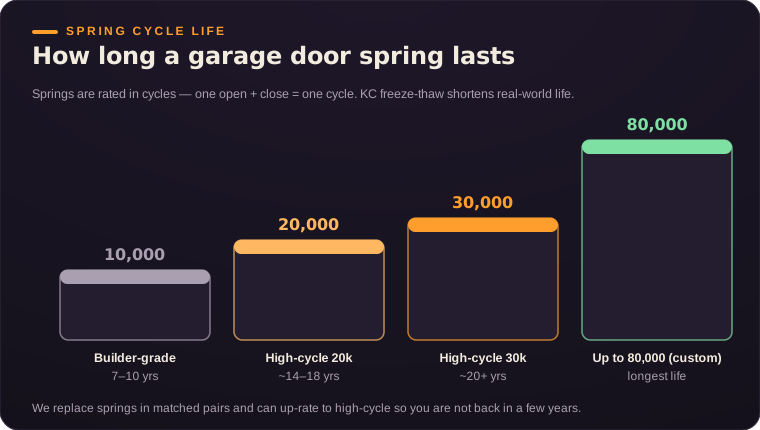
A very common question when we quote a spring job: can you just replace the one that broke and leave the other one? The short answer is no, and it is not a sales tactic — it is math. Here is the math. A standard residential torsion spring is cycle-rated: typically 10,000 cycles, with higher-cycle springs (custom high-cycle, built in-house up to 80,000 cycles) available for heavy-use and commercial doors. If your springs are 9 years old and the door has been used roughly twice a day, both springs have approximately 7,500 cycles on them. One spring just reached its fatigue limit and broke. The other spring has very nearly the same ~7,500 cycles on it — the same wear, the same micro-cracks, the same remaining life expectancy.
If we replace only the broken spring, you now have one new spring with zero cycles and one spring with 6,500 cycles. The new spring delivers full torque and winding energy; the old spring delivers whatever partial torque it has left. A door balanced on a mismatched spring pair runs one side tighter than the other. Over time the door tilts, the cables carry unequal loads, and the rollers on the over-tensioned side wear faster. The asymmetric load also puts a lateral stress on the center bearing plate that it was not designed for. And statistically, the second spring will fail within the next year or two — at which point you pay another $79 service call and another spring installation labor cost.
Replacing in matched pairs eliminates all of that. Both springs deliver the same torque, the door is balanced left to right, the cables carry equal loads, and the rollers wear evenly. You also get a door that feels smooth and responsive to the opener rather than fighting an asymmetric load. The cost difference between replacing one spring and replacing two springs is mainly labor — the tech is already there, the spring tube is already unwound.

When we replace your springs, we also do not just install the same cycle-rated spring that came with the door originally. We discuss whether upgrading to a higher-cycle spring makes sense for your usage pattern. A household with two parents and two teenagers going in and out three to four times a day accumulates cycles twice as fast as a retired couple with one car. For high-usage families, we build custom high-cycle springs in-house, up to 80,000 cycles — the upfront cost difference is modest and the service life is significantly longer. We explain the options, give you the price, and let you decide. No pressure, just information.
When you call Garage Door Masters KC at (913) 731-0190, a real person answers — not an answering service or a call center. We will ask you a few quick questions: did you hear a bang, is the door up or down, is there a visible gap in the spring? Those answers confirm the diagnosis and tell the tech what spring stock to bring. We carry standard residential torsion springs in the most common wire diameters, inside diameters and lengths for Johnson County, Jackson County, Wyandotte County, and the surrounding KC metro — which means most spring jobs are completable on the first visit without a parts run.
The tech calls you 10 to 30 minutes before arrival and texts if unable to reach you. On-site, the first thing we do is measure the spring size and confirm the door weight. If the original spring data is stamped on the winding cone, we record it. If not, we measure the old spring directly with calipers and a tape measure. Getting the spring specification right is non-negotiable — a spring that is the wrong wire size or length can over-wind, over-stress the tube, or fail to fully counterbalance the door, all of which create new problems.
The replacement process: we place winding bars into the winding cone sockets on the broken spring and release any remaining tension — even a broken spring can have residual tension that is dangerous if released without control. Then we loosen the set screws, slide the old spring off the tube, slide the new spring on, and set the screws at the correct position. Then the winding: we turn the winding bars in quarter-turn increments to add the torque specification for your door's weight. Standard quarter-turn count for a 7-foot door is typically 30 to 34 quarter-turns depending on spring length, but we calculate this from the door weight, not a generic number. Over-winding breaks the spring immediately; under-winding leaves the door unbalanced.
After winding, we attach the cables, cycle the door by hand several times to verify balance, then run it on the opener. We check the opener's force draw (a motor working too hard means the spring is slightly under-torqued), confirm the door holds at mid-travel without rising or dropping, and run the auto-reverse test with a 2×4 to make sure the safety system is calibrated correctly. The full spring replacement, balance check and safety test takes 45 to 60 minutes for a standard residential job. Most KC homeowners are back in business the same morning they call. The $79 service call applies toward the repair — you are not paying it on top of the spring job.
Not sure? Tap what your door is doing in the tool below and we'll tell you the likely cause in plain language — or just call (913) 731-0190 and a real person will sort it out.


Our own crew and trucks — jobs across the Kansas City metro.
Tap what’s happening — we’ll tell you what it usually is, in plain language, and how fast we can be out. No robots, no runaround.
Not sure? That’s fine — call (913) 731-0190 and a real person will sort it out, 7 days a week.
Every review above is a real, attributed Google review — no filtering, no incentives, no paraphrasing. Read all 490+ reviews and how we verify them →
Our tech was excellent! Came out on short notice on a Sunday. Five stars, and would wholeheartedly recommend to anyone looking for garage door repair or replacement.
We were able to get someone out very quickly. Our tech did an awesome job — very courteous and professional.
On time and always professional. Definitely recommend.
Very timely service. Highly professional work by our technician. Don’t forget to do your annual maintenance!
Thanks for making the drive to our place and attending to our needs so quickly and efficiently!
I was very pleased with the work done and the expertise displayed by our technician. He was punctual and professional.
The team at Garage Door Masters KC was professional and efficient. Highly recommend their services!
Fixed my garage in no time. Great to work with.
A real person answers, 7 days a week — same-day service across the KC metro.
Booking calendar loading — or call/text us now (a real person answers, 7 days):
Or call (913) 731-0190Or text usReal-time online booking. Prefer to talk? Call or text (913) 731-0190 — a real person answers, 7 days a week.
Type to search every page — try a city, a problem, or a part.