“
We were able to get someone out very quickly. Our tech did an awesome job — very courteous and professional.
SM
Susan M.★★★★★ · Google


A garage door that won't open is almost always a broken torsion spring or an opener problem.
A garage door that won't open is almost always a broken torsion spring or an opener fault. If you heard a loud bang—especially overnight or early morning—that's almost certainly a snapped torsion spring. The spring counterbalances the door's weight (150–350 lbs on a typical double-car door), and once it breaks the opener can't safely lift the door. Don't force it. If the motor runs but the door doesn't move, you likely have a stripped drive gear or a disconnected trolley. If the motor makes no sound, check the outlet and the GFCI breaker in the garage circuit. Kansas City's freeze-thaw winters—25–35 temperature cycles per year—are the hardest on springs in the region, and January–February is peak failure season. Garage Door Masters KC, based in Olathe, diagnoses won't-open calls the same day across the KC metro. Our $79 service call goes toward the repair, we quote a flat rate before starting, and we're bonded and insured. Most jobs are done in one visit.
The door won't lift at all — either the opener strains and stops, or nothing happens when you press the button.
We diagnose it on the spot and tell you the price before any work starts. A broken spring is replaced in pairs and the door rebalanced; an opener is repaired or replaced. Most of the time you're back in business the same visit.
Our service call is $79 and goes toward the job if we do the work the same day — and the price we quote is the price you pay. A real local tech comes out, often the same day, with the common parts already on the truck.
Same-day service at a fair price for a tension spring. Exactly what you want when the door won't open.

Before you call, run through these in order. Takes about 60 seconds and tells you exactly what to describe when you call.
Before calling us, run through this quick check — it takes 60 seconds and tells you exactly what to tell the tech when you call. First, did you hear a loud bang from the garage, possibly yesterday or overnight? If yes, that's almost certainly a snapped torsion spring. The spring stores tremendous energy and when it lets go it sounds like a gunshot. Your door is now a dead weight — do not force it, do not run the opener, do not try to pull it up by hand.
If there was no bang, try the wall button (not the remote). Does the opener motor run? If the motor runs and the belt or chain moves but the door doesn't lift, the drive gear inside the opener is stripped or the door is disconnected from the trolley (the emergency cord). If the motor doesn't run at all, check that the opener is plugged in and the outlet has power — a tripped GFCI in the garage circuit is a surprisingly common cause.
If the opener makes no sound at all but the outlet is fine, try the wall button while you hold the remote near the unit — if the wall button works but the remote doesn't, you likely just need a battery or a reprogram. If nothing works, the logic board or capacitor may have failed.

One more scenario: the door opens an inch or two then stops and the opener shuts off. That is almost always a spring failing under load — the opener can't lift the dead weight and the safety clutch triggers. Treat it like a broken spring and call us before the spring lets go completely.
This is the single fastest way to know what you’re dealing with before you call. With the door fully closed, pull the red emergency-release handle to disconnect the door from the opener, then lift the door by hand from the bottom corners.
What the door does tells you the cause. A healthy door glides up with two fingers and stays put halfway — its springs are doing the work. If it feels like dead weight (a real two-car door is 150–350+ lbs without working springs) and slams back down, the spring is broken — that’s your answer, and that’s also the point to stop. If the door lifts easily by hand but the motor hums, grinds, or won’t run, the problem is the opener, not the spring. Where it reverses is a tell, too: a door that rises a few inches and reverses is a spring failing under load.
Safety line: a door with a broken spring or a jumped cable is under real tension and can drop fast — leave it where it is, keep people and cars clear, and let a tech handle the wind-up. It’s the one garage-door job that sends DIYers to the ER. And never bypass or tape over the photo-eye safety sensors to force a door to move — they’re the required reversing safety, and a door that won’t open isn’t a sensor problem anyway.
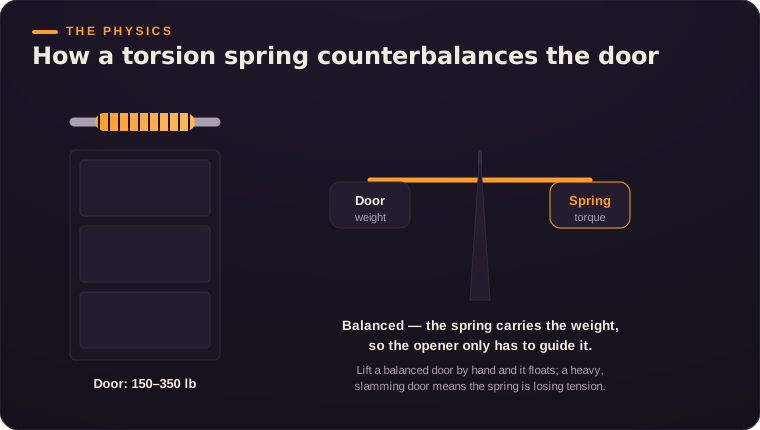
The torsion spring sits horizontally above your garage door on a metal tube. It is wound under enormous tension — enough to counterbalance a door that can weigh 150 to 350 pounds. That counterbalance is what lets a 45-pound opener move a 250-pound door. When the spring snaps, all that counterbalancing force is gone and your door becomes a solid dead weight that a residential opener cannot safely lift.
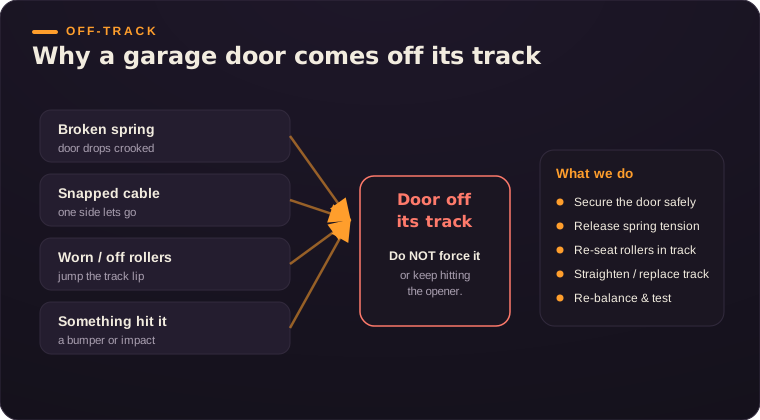
Trying to force an opener to raise a door with a broken spring puts tremendous strain on the opener motor, drive gear and trolley. In the best case you burn out the drive gear. In the worst case, the opener's safety clutch fails and a cable jumps, putting the door off-track. Now you have a spring repair and a cable and track repair instead of just a spring job.
Standard residential torsion springs are cycle-rated, typically to 10,000 cycles. For a typical household, that is about 7 to 10 years of life. Springs in the Kansas City metro rarely see ideal conditions — the temperature swings, humidity and occasional hard use mean many springs hit their limit closer to 7 to 8 years. When we replace your spring, we size it to your door's exact weight, install it in matched pairs so both sides are balanced, and wind it to the torque spec so the opener has the assist it was designed to get.

January and February are by far our busiest months for broken-spring calls across the KC metro, and it is not a coincidence. Kansas City sits in one of the most demanding climate zones for garage door hardware in the country. Winters bring extended sub-freezing stretches — often holding in the single digits or teens for days at a time — followed by rapid warm-ups that see temperatures climb 40 or 50 degrees in 24 hours. That freeze-thaw cycling is brutally hard on metal under tension.
Here is what happens at the mechanical level: steel becomes more brittle in the cold, and a spring that is already fatigued from thousands of cycles is most likely to let go on the first really cold morning of the season — or when temperatures swing hard from warm back to freezing. The coils contract, stress concentrates at the weakest point, and the spring cracks. Many of our spring calls come in between 7 and 9 a.m. when homeowners try to leave for work on a January morning and hear the bang.
The garage itself makes this worse. Most KC garages are unheated or only slightly conditioned, which means the door hardware is cycling through the full outdoor temperature range — unlike springs in a heated shop that stay closer to a stable temperature. Doors on the north or east side of a home (shaded from afternoon sun, taking the full brunt of northwest winter winds) tend to see springs fail earlier than doors on sun-facing sides.

Our suggestion to KC homeowners: if your door springs are approaching 8 to 10 years old, have them inspected before November. A pre-season inspection catches a spring that is one season from failing and lets you replace it on your schedule — a weekday afternoon instead of an emergency call the morning of a big snowstorm when everyone in the metro is calling at once.
The most important thing you can do after your garage door stops opening is nothing. Do not run the opener repeatedly hoping it catches. Do not pull hard on the emergency cord and drag the door up manually. Do not prop the door open with a ladder or a box — an unsprung door is extremely heavy and if it comes down it comes down fast.
Secure the space. If the door is stuck in the down position, your vehicle is probably trapped but your home is secure. If it is stuck open or half-open, close the garage interior door (the one going into the house), lock it, and keep the garage access restricted until we get there. If you are in a neighborhood with security concerns, call us on the emergency line — (913) 731-0190 — and we will advise whether to dispatch immediately.
If you absolutely must move the car and the door is stuck in the down position with a broken spring, here is the safest way: have a second person present, locate the red emergency release cord hanging from the trolley, and pull it to disconnect the door from the opener. Then both of you lift the door together from the bottom corners — do not grab the bottom panel edge where fingers can get pinched. Keep it open only long enough to move the car, then lower it slowly together and do not let it slam. Then leave it alone until we arrive. A single person should not attempt this with a broken spring.
One more note: if the door is stuck partially open, do not try to force it down either. A door with a jumped cable or a roller out of the track can come down crooked and jam the whole system badly, or trap you if a cable lets go mid-travel. Call us and we will tell you exactly what to do for your specific situation.
When you call Garage Door Masters KC, a real person answers — not a call center or answering service. We will ask you a few quick questions (did you hear a bang, does the opener motor run, is the door up or down) to make sure the tech brings the right parts. Torsion springs, drive gears and cables for the most common residential doors all ride on our trucks.
We call ahead 10 to 30 minutes before arrival and text if we cannot reach you. The tech diagnoses the door on the spot — usually in five minutes or less — and gives you a flat-rate price before any work starts. There are no hourly rates and no surprises on the invoice. The $79 service call goes toward the repair if we do the work the same day.
A standard torsion spring job takes 45 to 60 minutes: remove the old springs, measure and install the new pair, wind to spec, rebalance the door and run a safety check. A stripped opener gear takes 30 to 45 minutes. A cable and re-track job takes 45 to 90 minutes depending on how far the door has come off. We cycle the door multiple times after every repair to confirm it runs true and the opener is not fighting the balance before we leave.

Most KC homeowners are back in business the same day they call. If we get to you in the morning, the whole job is typically done before lunch.
Not sure? Tap what your door is doing in the tool below and we'll tell you the likely cause in plain language — or just call (913) 731-0190 and a real person will sort it out.
Don’t keep forcing it — a real KC tech can usually be out today. A real person answers 7 days a week, and the $79 service call goes toward the repair.Call (913) 731-0190Book online


Our own crew and trucks — jobs across the Kansas City metro.
Tap what’s happening — we’ll tell you what it usually is, in plain language, and how fast we can be out. No robots, no runaround.
Not sure? That’s fine — call (913) 731-0190 and a real person will sort it out, 7 days a week.
Every review above is a real, attributed Google review — no filtering, no incentives, no paraphrasing. Read all 490+ reviews and how we verify them →
We were able to get someone out very quickly. Our tech did an awesome job — very courteous and professional.
Fixed my garage in no time. Great to work with.
On time and always professional. Definitely recommend.
Thanks for making the drive to our place and attending to our needs so quickly and efficiently!
Very timely service. Highly professional work by our technician. Don’t forget to do your annual maintenance!
I was very pleased with the work done and the expertise displayed by our technician. He was punctual and professional.
Our tech answered, was at our house in 30 minutes, and had it fixed within the hour. Smart, friendly, skilled.
Same-day service at a fair price for a tension spring. Exactly what you want when the door won’t open.
A real person answers, 7 days a week — same-day service across the KC metro.
Booking calendar loading — or call/text us now (a real person answers, 7 days):
Or call (913) 731-0190Or text usReal-time online booking. Prefer to talk? Call or text (913) 731-0190 — a real person answers, 7 days a week.
Type to search every page — try a city, a problem, or a part.