“
Same-day service at a fair price for a tension spring. Exactly what you want when the door won’t open.
BH
Ben H.★★★★★ · Google


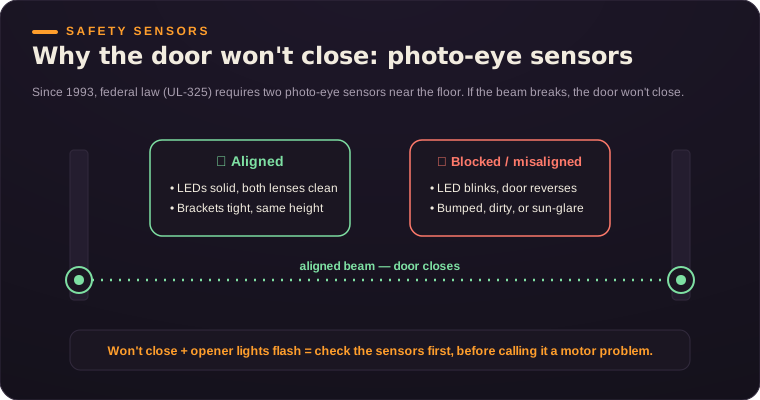
A garage door that won't close — or closes then pops back up — is almost always the photo-eye safety sensors near the floor being misaligned, dirty or blocked (look for a blinking opener light).
A garage door that won't close—or closes then reverses—is almost always the photo-eye safety sensors near the floor. Watch your opener's light: if it blinks when you press the button (10 flashes on most LiftMaster and Chamberlain units), the sensor beam is blocked or misaligned. Check the LED on each sensor—both should be solid, not flickering. A dark or blinking LED on the receiving sensor means the beam isn't making it across. Misalignment, a dirty lens, or a cobweb is usually the cause. In summer, direct afternoon sun shining into the receiver is a frequent KC culprit—the door works fine in the morning but won't close from 4–7 p.m. If the LEDs look fine, the down-force or travel-limit setting may be miscalibrated. Garage Door Masters KC, Olathe-based, realigns and tests sensors the same day across the metro. The $79 service call goes toward same-day work, and sensor realignment alone typically takes 15–20 minutes on-site.
The door starts down and reverses, won't move down at all, or the opener light blinks when you try to close it.
We realign and clean the sensors, check the wiring, and dial in the travel and force so the door closes fully and still auto-reverses safely. Most of these are quick fixes done the same visit.
Our service call is $79 and goes toward the job if we do the work the same day — and the price we quote is the price you pay. A real local tech comes out, often the same day, with the common parts already on the truck.
We were able to get someone out very quickly. Our tech did an awesome job — very courteous and professional.

Check these in order before you call. Takes about 60 seconds and covers 95% of won't-close cases.
Before you call, walk through this quick check — it takes about a minute and tells you exactly what to say when you describe the problem. First, watch the opener's light. When you press the button and the door won't close, does the wall-mounted light blink — 10 times for most LiftMaster and Chamberlain units? A blinking light is the opener telling you the photo-eye sensor beam is broken or misaligned. That single clue points you straight to the sensor as the cause before anyone touches anything.
Next, try holding the wall button rather than pressing and releasing. Most openers have a continuous-close mode: keep the wall button depressed and the door will often close even with a sensor issue, because the law requires the door to close when an adult is watching and actively pressing. If holding the wall button lets it close but a quick press does not, the sensor beam is definitely being interrupted — either by a misalignment, dirt on the lens, or something physically in the path.
Look low along both sides of the door opening. The photo-eye sensors mount about four to six inches off the floor on the vertical track brackets. One side sends an invisible infrared beam; the other receives it. Both should have a solid, steady LED — typically solid yellow on the sending side and solid green on the receiving side. A flickering or completely dark LED on the receiving side is a dead giveaway: the beam is not making it across. Check whether anything — a shovel, a box, a recycling bin, a leaf — is sitting in front of a sensor.

If both LEDs look solid and nothing is in the path, the issue may not be the sensors at all. Try closing the door at night or on an overcast day. If it closes fine then but fails in the afternoon sun, you have a sun-glare problem — more on that in the next section. If the door travels partway down and then reverses even in the dark with no obstruction, the down-force setting or travel limit is the culprit. Either way, call us and describe what you observed — it helps the tech confirm the diagnosis before arrival.
In 1993, federal law began requiring all residential garage door openers sold in the United States to include automatic reversing systems, including the photo-eye sensor pair. The rule came after documented injuries and deaths — primarily children — caused by doors closing on people and objects. That means if your opener was installed after 1993 (the vast majority of openers in service today), it has a sensor beam low at the door opening that the door cannot close through without immediately reversing.
Here is how the system works in practice. The sending sensor, typically mounted on one side of the door frame near the floor, emits a continuous narrow infrared beam across the opening to the receiving sensor on the opposite side. When nothing breaks the beam, the receiving sensor's LED is solid and the opener can close freely. The moment anything — a child, a pet, a bicycle, a falling object — breaks the beam during a close cycle, the opener instantly stops and reverses the door to full open. It also blinks the light to tell you why it stopped.
The sensors are deliberately placed low — four to six inches off the floor — so the beam sweeps the zone where a child or animal is most likely to be. Over time the sensors drift. The brackets are thin stamped metal that flexes slightly every time the door travels. Vibration from years of operation, being bumped by a broom or a bike tire, or ground settling under the door frame all gradually shift the aim. When the beam misses the receiving sensor by even a fraction of an inch, the opener sees a permanently broken beam and refuses to close. This is a safety feature working exactly as designed — but it means even a small physical bump can leave you with a door that won't close.
Kansas City homeowners see won't-close calls cluster in two distinct seasons, and both have the same root cause: the environment attacking the sensors. The first cluster is late summer afternoons, particularly July through September, when the sun is low enough in the western sky to shine directly into the receiving photo-eye. This is the most common won't-close call we get in summer across the metro — it happens between roughly 4 and 7 p.m. when the angle is just right. The door works fine in the morning and at night, which leads homeowners to think the sensor is intermittent or the opener is failing when it is simply sun glare on the lens.
The second cluster arrives in late winter and early spring. Kansas City's freeze-thaw cycles — those rapid 40-degree temperature swings from January through March — are hard on sensor brackets. Water gets into the gap between the bracket and the track, freezes, expands, and shifts the sensor angle slightly. By the time temperatures warm enough to melt the ice, the sensor is no longer aimed true and the door won't close. This often surprises homeowners because nothing obviously happened to the door over the winter — the sensor simply migrated over the course of repeated freeze-thaw events.
Spring and fall bring their own hazard: seasonal garage reorganization. Spring cleaning means bikes, garden tools, and patio furniture moving in and out of the garage, and a sensor bracket is exactly at knee height where it is easy to bump with a wheelbarrow or a ladder. Fall is the same story in reverse. We also see a surge in spider-web-blocked sensors in late summer. Kansas City's humidity — which runs 70 to 80 percent on many July and August days — encourages orb weavers to build webs in sheltered spots near the floor, and a fresh web spun overnight across the beam is enough to prevent the door from closing in the morning.

The practical takeaway for KC homeowners: if your door suddenly won't close on a sunny afternoon, try shading the receiving sensor with your hand while pressing the button — if it closes, sun glare is the cause and we can install a simple sun shield or adjust the bracket angle to solve it permanently. If it fails after a cold snap, inspect both sensor LEDs when the weather is cold versus warm to see if the LED status changes with temperature.
Not every won't-close problem is a sensor issue. The second most common cause is a miscalibrated down-force setting or travel limit — the two adjustments that tell the opener how far down to travel and how much resistance is too much. Every residential opener has both. The travel limit sets the end-of-travel position (where the door bottom meets the floor sill). The down-force setting controls how much force the motor applies before it decides it has hit an obstacle and reverses.
When the travel limit drifts short of the floor — which happens gradually on older units and can be triggered by a power surge or a battery-backup replacement — the door stops a few inches above the floor and reverses, as if it hit something. There is nothing there; the opener just thinks the door has reached its programmed endpoint too early. Conversely, if the garage floor has settled or heaved slightly (common in KC's expansive clay soils), the door may now hit the floor with more force than the down-force setting expects, causing it to reverse on contact.
Down-force is particularly sensitive on doors with any friction in the system — dry hinges, worn rollers, or a track with a slight twist all increase resistance. If the down-force is set conservatively (as it should be for safety), even moderate added friction will cause the opener to interpret the resistance as an obstacle and reverse. A tune-up — lubricating and adjusting the hardware — combined with down-force recalibration often solves this completely. We always recalibrate so the door stops flush at the floor and the auto-reverse still triggers properly on a 2×4 placed flat in the doorway (the standard test for down-force sensitivity).

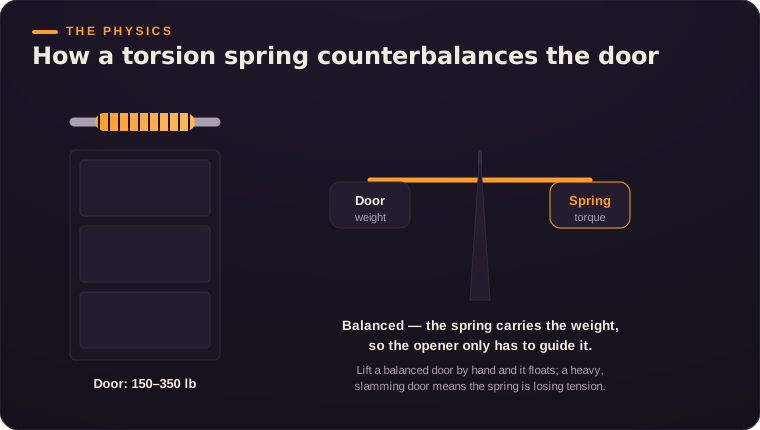
Before you blame the sensors or the settings, there is one quick test that tells you whether the problem is electronic or mechanical — and it takes about two minutes. With the door fully down, pull the emergency-release cord (the red handle hanging from the trolley) to disconnect the door from the opener. Now lift the door by hand to about waist height and let go. A properly balanced door floats and stays roughly where you leave it. If it slams back down or fights you on the way up, the springs or cables are out of balance — that is a spring or cable problem, not the opener, and the opener was reversing because it felt that extra resistance. Re-latch the trolley by pulling the cord toward the door and running the opener once before you test again.
Where the door reverses tells you why. If it reverses before it ever touches the floor (or won't start down at all and the opener light blinks), look at the photo-eye sensors first. If it reverses after it touches the floor — closes, then pops back up — that points at the down-travel limit or close-force, not the sensors.
One thing to never do: never bypass the photo-eye sensors — don't twist the wires together, tape the eyes facing each other on a shelf, or hold the wall button to force a door shut past them. That auto-reverse system is federally required and is the only thing standing between the closing door and a child, pet, or car in its path. If a wipe of the lenses and a glance at the LEDs doesn't fix it, the alignment, wiring, or down-force needs a real tech — all fast, affordable visits.
When you call Garage Door Masters KC, a real person picks up — no call center, no answering service. We will ask you two or three quick questions: does the opener light blink, does holding the wall button let it close, and does it happen at a specific time of day. Those answers let the tech confirm the diagnosis before arriving, which means faster service and the right parts on the truck if a sensor or sensor wiring needs to be replaced.
The tech calls ahead 10 to 30 minutes before arrival and texts if unable to reach you. On-site, the first thing we do is test the sensor LEDs and manually walk through the beam — this takes about 90 seconds. If the sensors are misaligned, we re-aim and tighten the bracket, clean the lenses, and confirm both LEDs are solid. Then we close the door three times: once in normal light, once with the sensor area shaded, and once with a test obstruction in the beam. If it passes all three, the sensors are good.
If the issue is down-force or travel limits, we adjust the settings using the opener's built-in calibration and test the auto-reverse per the 2×4 standard — the door should reverse on contact with the board without applying significant force to it. If a sensor is physically cracked or the bracket is bent beyond adjustment, we carry replacement sensors that fit most major makes, right on the truck.

The $79 service call goes toward the repair if we do the work the same day, so you are not paying it separately on top of whatever parts or adjustment work the door needs. Sensor realignment alone — the most common fix — takes 15 to 20 minutes. Even a sensor replacement or a full calibration pass is typically done within the same hour.
Not sure? Tap what your door is doing in the tool below and we'll tell you the likely cause in plain language — or just call (913) 731-0190 and a real person will sort it out.


Our own crew and trucks — jobs across the Kansas City metro.
Tap what’s happening — we’ll tell you what it usually is, in plain language, and how fast we can be out. No robots, no runaround.
Not sure? That’s fine — call (913) 731-0190 and a real person will sort it out, 7 days a week.
Every review above is a real, attributed Google review — no filtering, no incentives, no paraphrasing. Read all 490+ reviews and how we verify them →
Same-day service at a fair price for a tension spring. Exactly what you want when the door won’t open.
Showed up on time. Was a pleasure to work with. Solved our problem quick.
I was very pleased with the work done and the expertise displayed by our technician. He was punctual and professional.
On time and always professional. Definitely recommend.
Our tech answered, was at our house in 30 minutes, and had it fixed within the hour. Smart, friendly, skilled.
The team at Garage Door Masters KC was professional and efficient. Highly recommend their services!
Very timely service. Highly professional work by our technician. Don’t forget to do your annual maintenance!
Our tech was excellent! Came out on short notice on a Sunday. Five stars, and would wholeheartedly recommend to anyone looking for garage door repair or replacement.
A real person answers, 7 days a week — same-day service across the KC metro.
Booking calendar loading — or call/text us now (a real person answers, 7 days):
Or call (913) 731-0190Or text usReal-time online booking. Prefer to talk? Call or text (913) 731-0190 — a real person answers, 7 days a week.
Type to search every page — try a city, a problem, or a part.