

A new garage door is a 20-year decision and the biggest single panel of your home's curb appeal. Get it right and you'll barely think about it for two decades. Get it wrong — wrong material, wrong insulation, wrong installer — and you'll be calling for service within a few years. Here are the ten things that matter most, with context specific to Kansas City homes and the KC climate. For KC buyers, two of the ten carry more weight than national buying guides typically acknowledge: insulation tier (KC's 25–35 annual freeze-thaw cycles and 95°F summer highs make R-value pay off faster here than in most U.S. markets) and spring cycle rating (standard 10,000-cycle springs last 7–10 years in KC's climate; the high-cycle upgrade costs a little more at installation and avoids an early emergency call). The installer choice is the tenth item for a reason — even the right door produces problems when installed incorrectly. Garage Door Masters KC handles new-door sales and installation across the KC metro — authorized Clopay and DoorLink dealer, bonded and insured, free estimate, flat-rate pricing.

1. Material
Steel dominates the market for good reason: it holds up to Kansas City's hail season, resists denting better than aluminum, won't rot like real wood, and takes a factory-painted finish that outlasts anything you could apply on site. Most Clopay and DoorLink residential doors use 24- or 25-gauge galvanized steel — 24-gauge is stiffer and more dent-resistant, worth the step up if you have kids with bikes in the driveway.
Wood is beautiful but demands maintenance. KC's humidity swings — dry winters, humid summers — cause wood to expand and contract, which can warp panels and gap weather seals over time. If you love the look of wood, a composite or wood-embossed steel door gives you the visual without the upkeep. Real wood is worth it only if you're committed to refinishing every few years.
Aluminum and glass doors are growing in popularity for modern homes but are softer than steel and show dents more easily. They work well on sheltered garages and contemporary builds where the aesthetic is the point.

2. Insulation and R-value
Kansas City runs 25 to 35 freeze-thaw cycles per winter, with temperatures that can swing 40 degrees in 24 hours. An insulated door — especially on an attached garage — makes the space dramatically more comfortable, reduces noise transmission, and is actually more dent-resistant because the foam core stiffens the panel.
R-value measures thermal resistance. A rough guide for KC homes:
- Unattached storage garage: R-0 to R-6 is fine. You're not heating it.
- Attached garage, daily use: R-12 to R-18. This is where most KC homeowners land — it's the sweet spot of comfort and cost.
- Bedroom, bonus room, or office above the garage: R-12 to R-18.4. The floor above a cold garage is miserable in January without serious insulation.
For a deeper look at R-value options and KC-specific advice, see our insulated garage doors guide.

3. Construction quality
Two doors can have the same R-value but very different construction. Polyurethane (foam-injected) doors have the foam bonded to both steel skins — they're stiffer, quieter, and more thermally stable than polystyrene (the bead-board sheets that slide into channels). For an everyday-use door in KC where temperature swings are real, polyurethane is worth the premium.
Also check hinge gauge and roller quality. Standard hinges are stamped from lighter steel; commercial-grade hinges are heavier and last longer. Factory-installed nylon rollers run quieter than steel and don't need lubrication. The bottom seal quality matters too — a cheap rubber seal will crack and shrink in our cold winters within a few seasons.
4. Style
Match the door to the architecture of your home, not just whatever looks good on its own. Traditional raised-panel doors are versatile — they work on ranch homes, split-levels, and brick colonials throughout Kansas City metro and the KC suburbs. Carriage-house overlay styles (which use a flush door underneath with decorative overlay panels and hardware) suit Cape Cod, Craftsman, Tudor, and older colonial homes common in neighborhoods like Leawood, Prairie Village, and older parts of Shawnee.
Modern steel and aluminum full-view glass doors belong on contemporary builds — they look sharp on new construction in development communities but can look out of place on a 1990s brick ranch. When in doubt, try our Door Visualizer, which lets you upload a photo of your actual home and preview styles and colors before you commit.
5. Color and finish
Factory-painted finishes baked on at the manufacturer level outlast any field-applied paint by years. Clopay's polyester finish resists chalking and fading significantly better than what a painter could roll on. Dark colors (deep brown, black, charcoal) absorb more heat and can get very hot on a south- or west-facing garage in KC summers — not a dealbreaker, but worth knowing if your garage houses heat-sensitive items or if you have a bedroom adjacent.
Woodgrain embossed finishes are a popular middle ground — they look like real wood from the street but are maintenance-free. Clopay's Canyon Ridge and Coachman lines, and DoorLink's carriage styles, offer convincing woodgrain options that hold up well in our climate. Custom colors are available on special order if you want to match your home's trim exactly.
6. Windows
Windows add natural light to the garage and significantly improve curb appeal on carriage and modern door styles. The trade-off is that every window panel breaks the insulated section, slightly reducing overall R-value and creating a potential privacy concern if you store valuables.
For privacy, specify obscure (frosted or textured) glass — it transmits light but no one can see what's inside. Tempered safety glass is standard on quality doors and required in most applications. Consider adding windows only on the top row of panels: this gives you light from high up where it scatters well, without sacrificing the privacy of the lower panels. Avoid windows altogether if your garage faces a busy street and you'd rather not broadcast the contents.
7. Hardware
Decorative door hardware — handles, hinges, strap accents — completes a carriage-house look and is mostly cosmetic on modern doors (the real structural hinges are inside). The hardware worth paying attention to is what you can't see: roller quality, hinge gauge, and the bottom seal.
If you're getting a new door, it's the perfect time to request nylon rollers as an upgrade over steel. They run 50% quieter and don't need the periodic lubrication that steel rollers demand. For KC winters, a high-quality bottom rubber seal rated for cold temperatures is worth specifying — cheap seals get brittle and crack in sub-zero nights, letting cold air and moisture under the door.
8. The opener
The opener is arguably as important as the door itself for daily livability. Your main choices:
- Belt drive: Quietest option, ideal under a bedroom or bonus room. LiftMaster's belt-drive lineup is what we recommend for most KC homes — smooth, reliable, and smart-home ready.
- Chain drive: Loud but durable. Fine for a detached garage where noise doesn't matter, but not what most attached-garage owners want.
- Wall-mount (jackshaft): Mounts beside the door instead of on the ceiling, freeing up overhead space for storage or high-clearance items. Works with modern and full-view glass doors where a traditional trolley opener would look wrong.
Battery backup is worth prioritizing in the KC market. Ice storms, tornado season, and summer thunderstorms knock out power in the metro with some regularity — a battery-backup opener means you can always get in and out even when the power is down. LiftMaster's 8550W and similar units include built-in battery backup. It's not an expensive add-on, and one less thing to worry about.
For smart-home integration, LiftMaster's myQ platform lets you open, close, and monitor the door from your phone. The Amazon Key integration automatically lets Amazon packages into your garage, with no human needed at home. These are genuine usability upgrades, not just marketing features.
9. Spring cycle rating
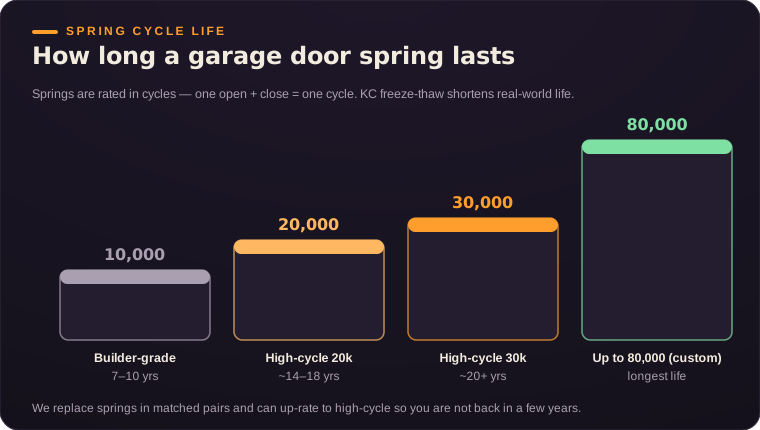
Springs are the single most-replaced component on a garage door, and their cycle rating determines how long they last. A "cycle" is one full open-and-close sequence. Standard springs are rated for 10,000 cycles — at 4 uses a day, about 7 years — and up to 10 with lighter use. Custom high-cycle springs, built in-house up to 80,000 cycles, cost more upfront and last noticeably longer at the same usage rate.
In Kansas City, springs fail most often in January and February, when steel contracts in the cold and accumulated metal fatigue from summer heat meets its weakest point. This isn't bad luck — it's physics. If you're having a new door installed and your budget allows, upgrading to high-cycle springs at the same time is an easy call: the door comes off anyway for installation, and spring labor is a fraction of the cost of a separate service call later.
Always replace springs in pairs. If one breaks, the other has equal wear — replace both or you'll be calling for service again within months when the second one goes.
10. The installer
A door is only as good as its installation. Measure wrong by a quarter inch and the door will bind, gap at the sides, or fail to seal at the bottom. That means air infiltration, water intrusion, and a voided manufacturer's warranty. The cheapest installation quote often costs the most over the life of the door.
What to look for in an installer:
- Authorized dealer: An authorized Clopay or DoorLink installer has completed factory training, uses genuine replacement parts, and can honor the manufacturer's warranty. Box-store installs often use third-party contractors who aren't factory-authorized — which can void door and hardware warranties.
- Bonded and insured: In Kansas, there's no state licensing requirement for garage door installers (a fact often confused by homeowners). Bonded and insured is the real credential — it protects your property if something goes wrong during the install.
- Labor warranty: A local crew that stands behind their work with a written labor warranty is worth more than any discount. Get it in writing.
- Local vs. national franchise: A local owner-operated company like Garage Door Masters KC sends the same crew you booked — not a rotating subcontractor pool. The owner or one of our trained techs will be at your door. That means accountability and follow-up if anything needs adjustment.
Our installation page explains exactly what happens on install day — from the opening measurement to the final test cycle and walkthrough.
Ready to choose?
Use the Door Visualizer to try styles and colors on a photo of your home, browse the Clopay product catalog, or book a free on-site measure and estimate. We come out, take the opening measurements, show you options from our authorized lineup, and hand you a written flat-rate price with no pressure and no obligation.
Call or text us at (913) 731-0190 — we're available 7 days a week and cover the full KC metro in Kansas and Missouri.