

The garage door opener market has exploded over the past decade — belt drive, chain drive, wall-mount, DC motors, battery backup, myQ connectivity, built-in cameras, Amazon Key. For most KC homeowners replacing an aging opener or installing one for the first time, the number of options is paralyzing. This guide cuts through it. We service and install openers across the entire KC metro every week, and we will tell you exactly which choices matter, which are noise and which are not, and what is uniquely relevant for Kansas City's climate and home stock. The short practical answers: choose belt drive if your garage shares a wall or ceiling with living space — it is significantly quieter than chain; choose chain drive if cost matters most and the garage is fully detached; choose wall-mount if you have a low, sloped, or finished ceiling where a rail-type opener will not fit. Add battery backup if the garage is your only entry point — KC's tornado season and winter ice storms make multi-day power outages realistic, and a dead opener that can't be opened manually from outside strands you. Garage Door Masters KC installs LiftMaster and Chamberlain openers across the metro. $79 service call, same-day scheduling, flat-rate pricing.

Start here: the four decisions that actually matter
An opener purchase comes down to four decisions. Everything else is either a refinement or a feature you can add later.
- Drive type — belt, chain, or wall-mount. Sets the noise level and maintenance profile.
- Horsepower — matched to your door's weight and size. Wrong here = early failure.
- Battery backup — strongly recommended for attached garages in KC's storm and ice season.
- Smart connectivity — myQ monitoring is practical. Decide how much smart integration you want before shopping.
Brand is secondary to these four choices. We install and service LiftMaster and Chamberlain — both are reliable, both have the feature sets most KC homeowners need, and both carry strong manufacturer warranties. Avoid generic offshore brands sold at warehouse stores; they cut costs on the trolley system and drive components that see the most wear.
| Belt drive | Chain drive | Wall-mount (jackshaft) | |
|---|---|---|---|
| Noise level | Quiet — belt absorbs vibration | Loud — metal chain on sprocket | Near-silent — no overhead drive |
| Maintenance | Minimal — no belt lubrication | Annual chain lube + tension checks | Minimal — no chain or rail |
| KC winter performance | Consistent — belt unaffected by cold | Can get noisier as lubricant thickens | Consistent — no exposed chain |
| Ceiling required | Yes — 10–12″ headroom above door | Yes — 10–12″ headroom above door | No — mounts on side wall |
| Best for | Attached garages — esp. with living space above/adjacent | Detached garages; budget priority | Workshops, finished ceilings, overhead storage, low headroom |
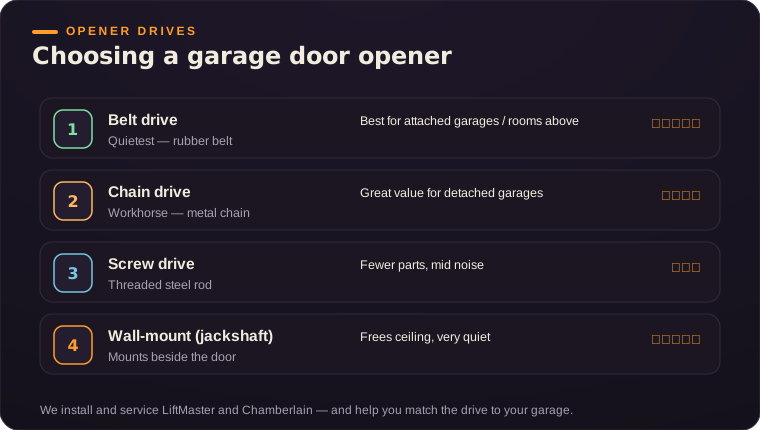
Drive type: belt, chain, and wall-mount explained for KC garages
The drive type is the single choice that most affects day-to-day experience — primarily noise level — and it interacts with KC's climate in specific ways worth understanding.
Belt drive: the right choice for attached KC garages
A belt-drive opener uses a polyurethane or steel-reinforced rubber belt running along the drive rail. The belt absorbs vibration rather than transmitting it, making belt-drive openers significantly quieter than chain drives — the difference is roughly equivalent to running a dishwasher vs. running a garbage disposal. In an attached garage where a bedroom, home office, or living room shares a wall or ceiling with the garage, that difference is audible and cumulative across every open-close cycle.
Belt drives are also lower-maintenance. The belt does not require lubrication and does not stretch or develop the slack that a chain drive accumulates over years of use. In KC's temperature range — lows near 0°F in January, highs above 95°F in July — belt drives perform consistently without the cold-weather noise increase that chain drives can develop as chain lubricant thickens.
Chain drive: durable, lower-cost, works well in detached garages
Chain drives use a metal roller chain (similar to a bicycle chain) running on a drive sprocket. They are the most common drive type installed in the KC metro over the past 30 years, and many are still running well 15+ years later — chain drives are durable. They are also lower-cost, which matters when an opener replacement was unplanned.
The drawbacks: noise (a chain drive vibrates the entire drive rail and can be heard through walls and ceilings) and maintenance (chains need periodic lubrication and may need tension adjustment as they stretch). In winter, KC's cold temperatures thicken the lubricant on the chain, which can make the opener louder and slower in January compared to October. Annual chain lubrication with a chain-compatible lubricant (not WD-40, which is a thin penetrant) addresses this.
Bottom line: chain drive is the right call for a detached garage where noise is not a concern and budget is a priority. For attached garages, the noise difference is real enough that most KC homeowners who switch to belt drive comment on it within the first week.

Wall-mount (jackshaft) openers: when they make sense in KC
Wall-mount openers (LiftMaster 8500W series and similar) mount on the wall beside the door rather than on a ceiling-mounted drive rail. They operate by turning the torsion spring shaft directly via a side-mounted jackshaft. This frees up ceiling space entirely — relevant in KC garages used as workshops, with overhead storage racks, or converted spaces where ceiling obstructions prevent a standard rail installation.
Horsepower: matching the opener to the door
An opener's horsepower rating is a rough proxy for lifting capacity. The real number that matters is the peak torque the motor can produce — but horsepower correlates well enough for practical selection decisions.
1/2 HP: the baseline for most standard KC doors
A 1/2-horsepower opener handles single-car doors (8–9 feet wide) and lightweight double-car doors without insulation. In KC, this covers a large portion of the housing stock — particularly ranch homes built in the 1980s and 1990s with standard 16×7 or 9×7 steel doors that are single-layer or lightly insulated.
The key test: if you disconnect the opener and manually lift your door, it should rise smoothly with one hand and hold its position at midpoint with minimal drift. If it feels heavy or requires significant effort, the springs may be worn (add that to your repair list) or the door itself may exceed the 1/2 HP capacity. A door that passes the balance test and is under about 175–200 lbs is safely in 1/2-HP territory.
3/4 HP: recommended for heavy insulated doors and wide double-car doors
The shift to 3/4 HP is warranted for: double-car doors 16 feet or wider (especially 18×7 or 18×8), polyurethane-insulated models like the Clopay Coachman or Canyon Ridge (which are meaningfully heavier than single-layer steel), wood or wood-composite doors, and any door showing signs of spring wear that you want to run for another season before replacement.
In KC, the push toward higher insulation values — driven by our 25–35 annual freeze-thaw cycles and the value of moderating temperature in attached garages — means heavier doors are increasingly common. A Clopay Canyon Ridge with Intellicore polyurethane insulation weighs substantially more than the builder-grade steel door it replaces. Pairing a heavy insulated door with a 1/2-HP opener is a common mistake that leads to premature motor failure, stripped drive gears, and frustrating service calls within 3–4 years.
Battery backup: why it matters more in KC than most US cities
Standard opener models stop working when the power goes out — the motor requires 120V AC, and without it, the door can only be operated via the manual emergency-release cord. That is manageable in most situations, but Kansas City has two seasons of notable power disruption:
- April–May severe storm and tornado season — the KC metro sits in the central Midwest tornado corridor. Severe storms that knock out power for hours are an annual event. Straight-line wind events during spring derecho storms can leave neighborhoods without power for 12–24+ hours.
- January–February ice storms — freezing rain events that ice down power lines and utility equipment are a recurring KC winter feature. A significant ice storm can cut power for 6–24 hours across parts of the metro.
A battery-backup opener (LiftMaster 8550W, 87504, Chamberlain C2405, and similar) runs on a trickle-charged 12V battery integrated into the opener head. During a power outage, the unit automatically switches to battery operation and provides approximately 20 cycles (for a standard door) before the battery is depleted. Most outages — including the typical KC storm outage — resolve well within those 20 cycles.
The practical scenario: it is 6 a.m. on a February morning, the power is out after an overnight ice storm, and you need to leave for work. Without battery backup, you pull the emergency-release cord, lift the door manually (not difficult in normal conditions, but awkward when it is icy and dark), park and re-enter manually, and hope you remember to re-engage the opener when the power returns. With battery backup, the opener works as normal throughout. For an attached garage — which describes the majority of KC homes — we recommend battery backup as a default, not an optional upgrade.
Smart features: what's practical vs. what's marketing
Smart opener features have improved significantly in the past five years. The genuinely useful ones versus the noise:
myQ monitoring: the one feature that changes daily habits
myQ (LiftMaster and Chamberlain's connected-home platform) gives you real-time status of the door from your phone and lets you open or close it remotely. The monitoring function is the most-used: virtually every homeowner who installs myQ reports using the "did I leave the garage door open?" check within the first week, and most report closing the door remotely at least a few times per month. The remote-open function is useful for letting a delivery driver, house cleaner, or family member in without a physical key.
Amazon Key for Garage: real theft prevention in a metro area
Amazon Key for Garage allows Amazon delivery drivers to place packages inside your closed garage rather than on the front porch. The driver uses a one-time access code through the myQ system, the door opens and closes automatically after the delivery, and you receive a notification with a timestamp. For KC homeowners who order frequently and are concerned about porch theft, this is a practical feature — the garage is far more secure than a porch, and the access is logged and single-use. It requires a myQ-enabled opener and an active Amazon Key subscription (included with Prime for eligible addresses).
Built-in cameras: useful if you want a garage view
LiftMaster's 87504 and similar models include a built-in HD camera in the opener head, pointed toward the garage interior. The camera streams live to the myQ app and stores video clips triggered by door activity. This is genuinely useful if you use your garage as a workspace, store valuables, or just want a view of whether the car is in and the door is closed. It is not a security camera in the perimeter sense, but it adds visibility. If you do not actively want a garage interior camera, it is not worth a premium — the myQ monitoring function provides the key safety benefit (door status) without it.
Door compatibility: what to check before you buy
Most standard residential doors in the KC metro are compatible with standard rail-mounted openers without modification. There are a few situations worth checking:
Headroom clearance
A standard 7-foot door requires approximately 10–12 inches of clearance above the door in the open position for the opener's mounting bracket and the rear of the drive rail. Garages with low headroom — common in some older KC ranch homes and split-levels built in the 1960s and 1970s — may have only 6–8 inches of clearance, which requires a low-headroom bracket kit. This is a routine accommodation; flag it when you call so we bring the right hardware.
Door balance
Any opener works best on a properly balanced door. If your springs are worn and the door is heavy (it drops quickly when released at midpoint in the balance test), the opener compensates for the spring deficit on every cycle — dramatically shortening motor and drive-gear life. We routinely find worn springs when we come for an opener replacement. The combination repair — new opener plus spring service — is the honest recommendation in those cases. We will tell you if the door balance is an issue before we install anything.
Very old single-panel tilt-up doors
Pre-1985 KC homes with single-panel tilt-up doors (the door swings out at the bottom and up as a single flat panel, common before sectional doors became the standard) can be compatible with standard openers using a special adapter bracket, but the installation is more involved and the tilt-up mechanism puts unusual stress on the opener during each cycle. If your garage has a tilt-up door, let us know when scheduling — we can assess whether an opener-only install makes sense or whether the economics favor a full door and opener package.
Our recommendation for most KC homes
For the typical KC attached garage — double-car sectional door, moderate to high insulation, active household with storm season concerns — the combination we install most often is:
- LiftMaster belt-drive motor with battery backup (8550W or current equivalent)
- 3/4 HP for insulated or wide doors; 1/2 HP for lightweight standard doors
- myQ connectivity for door monitoring
- Spring balance check alongside installation
This setup handles KC's climate reliably, eliminates the "did I leave the door open" anxiety, keeps the garage accessible during power outages, and runs quietly enough not to disturb the house at 6 a.m. It is not the cheapest option on the shelf — but it is the one that does not generate a service call within three years because the drive system was undersized or the chain started rattling in winter.
If budget is the primary constraint, a 1/2-HP chain-drive from LiftMaster or Chamberlain with myQ is a solid middle path for a detached garage or a lightly used single-car door. We will give you the same honest assessment in person — call us or book a free consultation before you buy, and we will tell you exactly what makes sense for your specific door and garage setup.
Installation takes 60–90 minutes. The $79 service call applies toward the same-day install. We carry LiftMaster and Chamberlain on the truck; if you want a specific model, let us know when you call and we will confirm availability. Learn more about our opener installation service.